
How to Search Contra Costa County Court Records
The Contra Costa County Superior Court online services page is the front door for case lookup. As of April 27, 2026, the Court Public Portal moved to a new Tyler-hosted site at kiosk-cacontracosta.tylertech.cloud/Portal/. The portal covers civil, small claims, probate, family law indexes, criminal calendars, and hearing data. Traffic cases use a separate Traffic Public Portal. The court warns that the portal is not the official record. For certified copies, the user must visit or write to Court Records at Room 103, Wakefield Taylor Courthouse.
Before starting a search, gather the case number if known, the full party name with correct spelling, and the date range. A valid photo ID is required to view paper files in person. Common case-number prefixes show the courthouse of origin. Martinez cases often begin with MS. If a case is not found at one location, try a name search or another courthouse filter. The court also warns that old microfiche and paper files are being scanned, so some requests can take longer than usual.
A direct look at the Superior Court homepage shows the notices, the Coco beta chatbot, and the link to the moved portal.
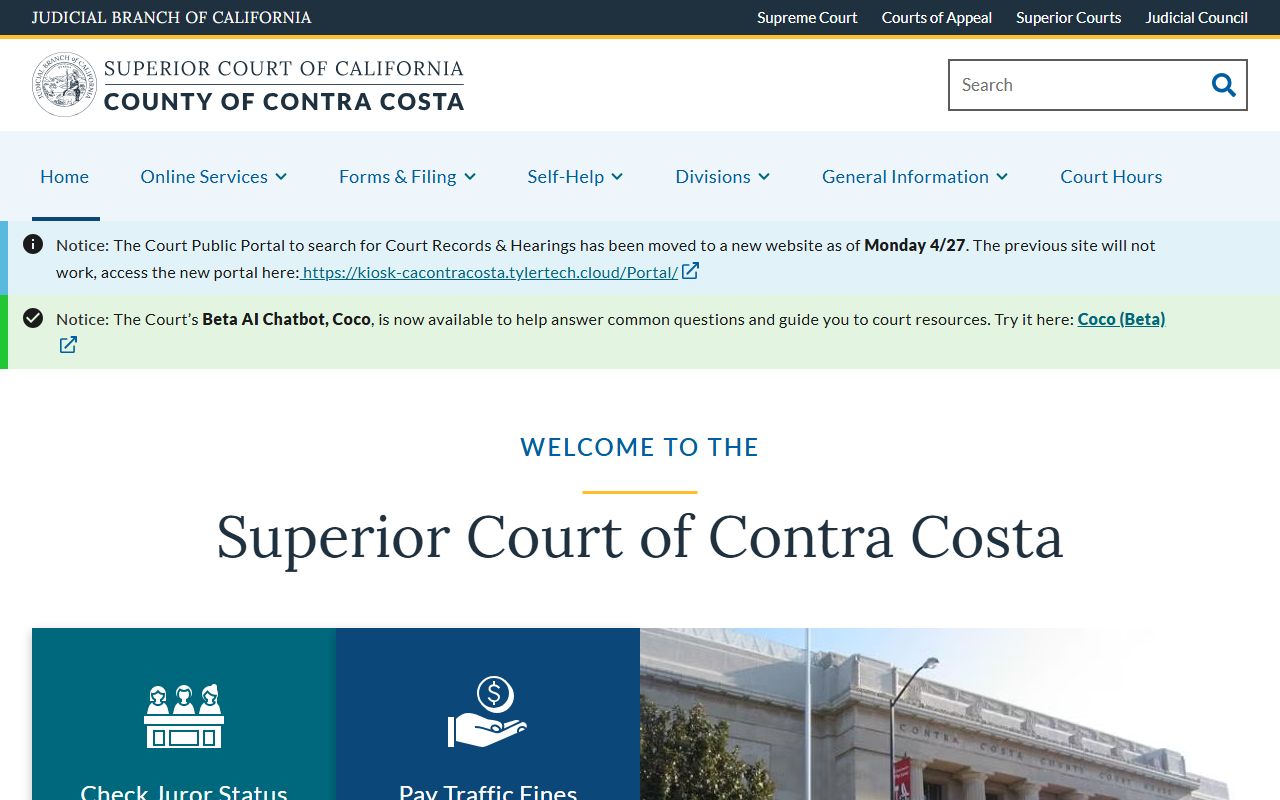
The homepage also points users to e-filing, juror status, traffic payment, and the new portal address.
- Open the Court Public Portal at kiosk-cacontracosta.tylertech.cloud/Portal/ and accept the posted terms.
- Pick Smart Search, then enter a case number, a party name, a business name, or an attorney name.
- Narrow by court location, case type, or date range using the filters on the screen.
- Open the result to read the case caption, parties, judge, register of actions, and hearing dates.
- Download free civil documents and minutes where the portal posts them, or request a certified copy from Court Records.
The Contra Costa County Judicial System
California unified its trial courts in 1998. Each of the 58 counties now runs one Superior Court. There is no state district court at the county level. Contra Costa County Court cases of every type sit inside the Superior Court of California, County of Contra Costa. Appeals from this court move to the California Court of Appeal, First Appellate District. The California Supreme Court takes a small share of cases on discretionary review. Federal cases from the county go to the U.S. District Court for the Northern District of California, which is a federal court and not part of the state trial court structure.
The Superior Court hears felony, misdemeanor, civil unlimited, civil limited, small claims, unlawful detainer, family law, juvenile, probate, traffic, and restraining order matters. Presiding Judge Christopher Bowen sits in Department 1, Room 209, with a public line at (925) 608-1101 per the court directory. Martinez holds the main court campus. Richmond serves West County. Pittsburg serves East County. Walnut Creek runs juvenile and traffic functions.
Case flow: Superior Court › Court of Appeal (First District) › California Supreme Court
| Court | Jurisdiction | Case Types |
|---|---|---|
| Superior Court of California, County of Contra Costa | Trial court for the county | Felony, misdemeanor, civil, family, probate, traffic, small claims |
| California Court of Appeal, First Appellate District | Intermediate state appeals | Appeals from Superior Court rulings and judgments |
| California Supreme Court | Top state court | Discretionary review of state appellate rulings |
| U.S. District Court, Northern District of California | Federal trial court | Federal civil, criminal, and federal-question cases from the county |
Contra Costa County Courthouses
Court services in Contra Costa County are spread across seven public sites listed on the court locations page. The Wakefield Taylor Courthouse in Martinez is the main hub. It holds Court Records, the Presiding Judge, court administration, and most criminal, civil, and probate hearings. Spinetta Family Law Center handles family law. The George D. Carroll Courthouse in Richmond serves West County. The Richard E. Arnason Justice Center in Pittsburg serves East County. The Walnut Creek site handles traffic and juvenile matters.
The locations index shows the full set of buildings and the case types each one hears.
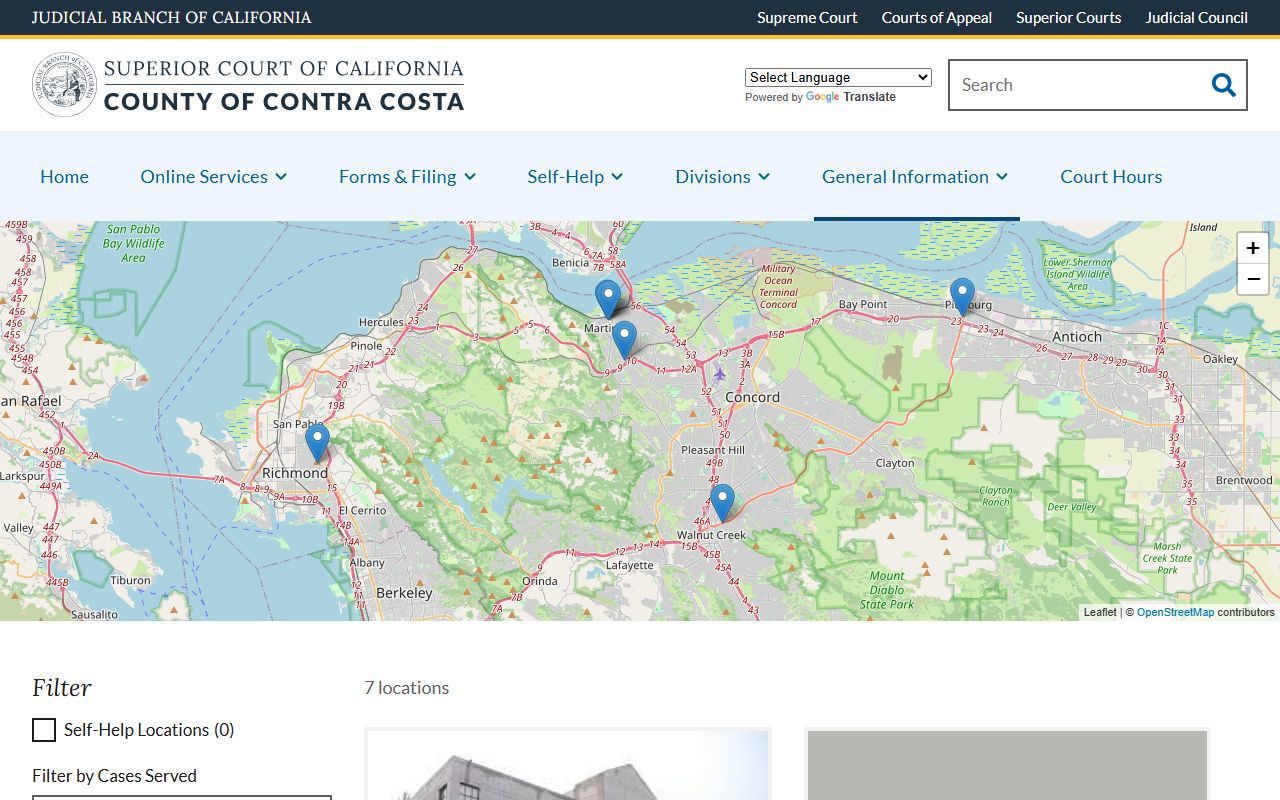
Each card on that index lists a street address, a phone number, and the case-type filter for that site.
Wakefield Taylor Courthouse
725 Court Street
Martinez, CA 94553
(925) 608-1000
George D. Carroll Courthouse
100 37th Street
Richmond, CA 94805
(925) 608-1000
Richard E. Arnason Justice Center
1000 Center Drive
Pittsburg, CA 94565
(925) 608-1000
The Wakefield Taylor location page lists hours, Court Records details, and the law library hours.
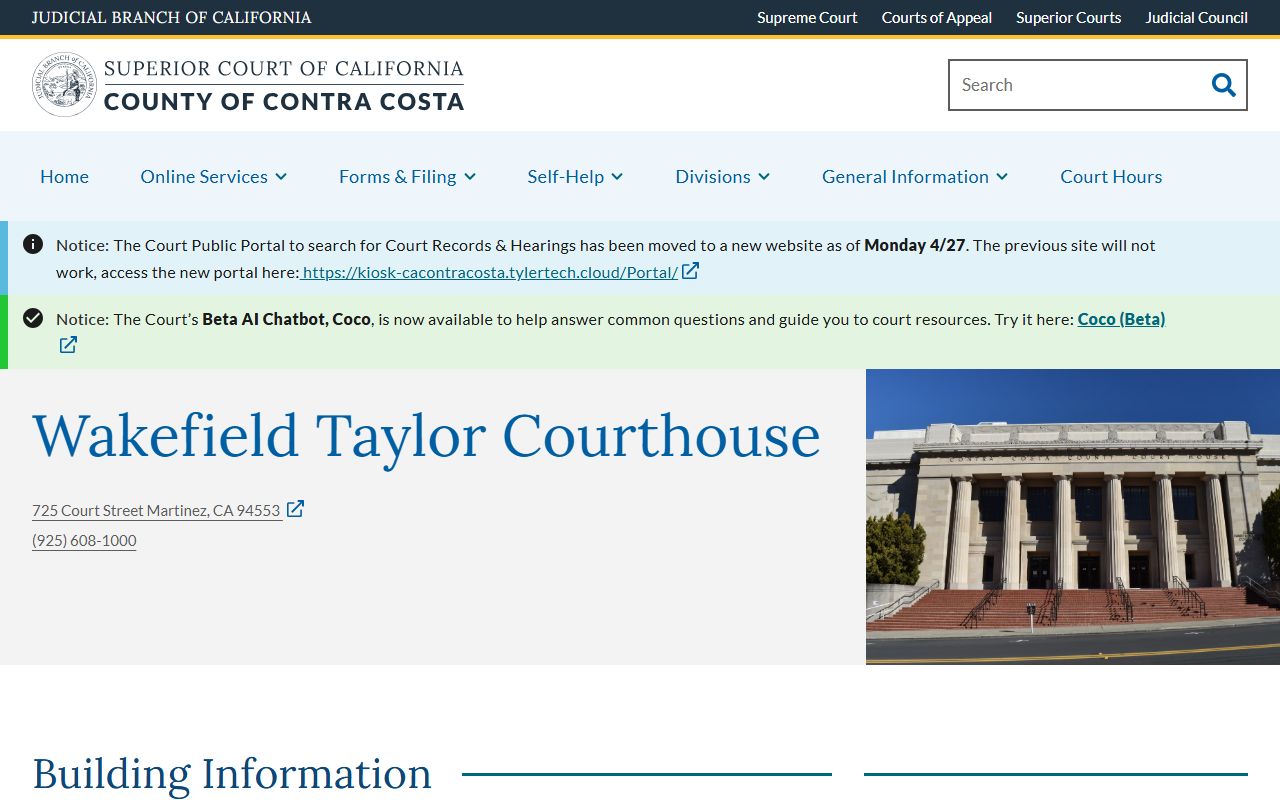
That same page is the source for the (925) 608-1000 phone line and the 8 a.m. to 4 p.m. building hours.
Types of Court Records Available in Contra Costa County
The Superior Court holds many kinds of files. Civil cases run from contract claims to torts. Criminal cases run from infractions to felonies. Family law covers divorce, custody, support, and restraining orders. Probate covers wills, trusts, conservatorship, and guardianship. Traffic covers tickets and minor infractions. Juvenile and adoption files are confidential by state law. Each record type has its own rules for what the public may see online and what must be viewed in person.
Civil and small claims files often appear in full on the portal. Family law indexes show, but most family documents do not stream online due to California Rule of Court 2.503. Criminal documents are reviewed in person at the criminal clerk. Limited unlawful detainer cases are blocked from online view under Code of Civil Procedure section 1161.2.
- Criminal records - Complaints, arraignment minutes, plea forms, sentencing, and probation terms from adult criminal cases.
- Civil records - Complaints, answers, motions, orders, and judgments from unlimited and limited civil cases.
- Family and divorce records - Dissolution, custody, support, and domestic violence files from the Spinetta Family Law Center.
- Probate records - Wills, estates, trusts, conservatorship, and guardianship files from the Probate Division.
- Traffic records - Tickets, infractions, and arraignment data from the separate Traffic Public Portal.
The Court Records page spells out the access rules for non-criminal cases.
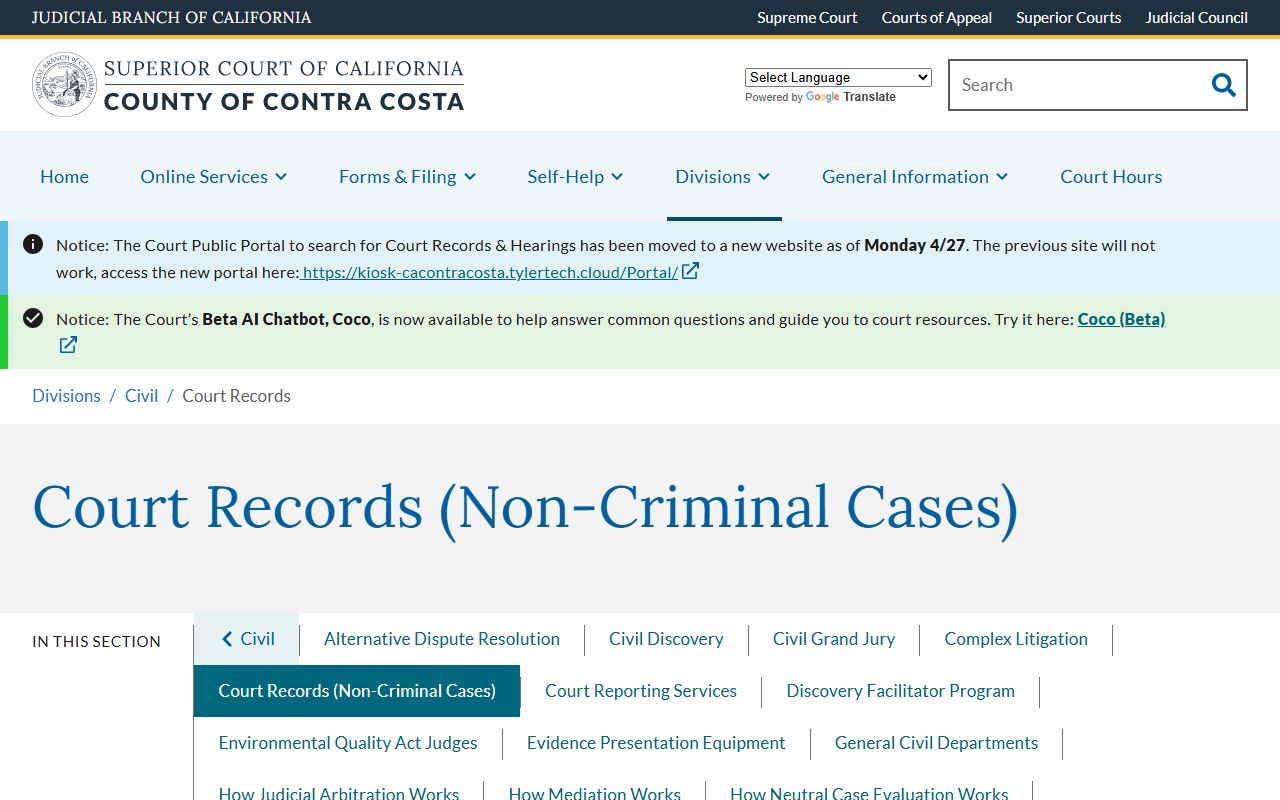
That page also confirms the ID rule and the copy fees in force at the Court Records Unit.
What Contra Costa County Court Records Show
A public case record on the Court Public Portal lists a set of core fields. The case number, case type, parties, judge, hearing dates, register of actions, and document links are the bones of any file. Civil documents and minutes are free to download for many case types. Some fields stay hidden by law. Social security numbers, full dates of birth, financial account numbers, minor names, sealed material, and protected addresses are redacted or blocked.
| Field | What It Shows |
|---|---|
| Case Number | Full court case ID, often with a courthouse prefix such as MS for Martinez. |
| Filing Date | Date the initiating document was filed with the clerk. |
| Parties | Plaintiff, defendant, petitioner, respondent, decedent, ward, or conservatee. |
| Charges / Cause | Charge code, statute, or cause of action with level shown where public. |
| Disposition | Active, disposed, dismissed, judgment entered, sealed, or transferred. |
| Sentence / Judgment | Final order or sentence, including probation, fines, or relief granted. |
The portal also shows the register of actions, attorney info, and links to free document downloads for civil and small claims.
Public Access Laws for Contra Costa County Court Records
Court files in California sit under three sets of rules. The California Public Records Act covers most local agency records. The California Rules of Court cover case files. Rule 10.500 covers judicial administrative records. The Superior Court explains the split on the Judicial Branch public records page. Court case files are open by default but with key limits for family, juvenile, mental health, and sealed matters.
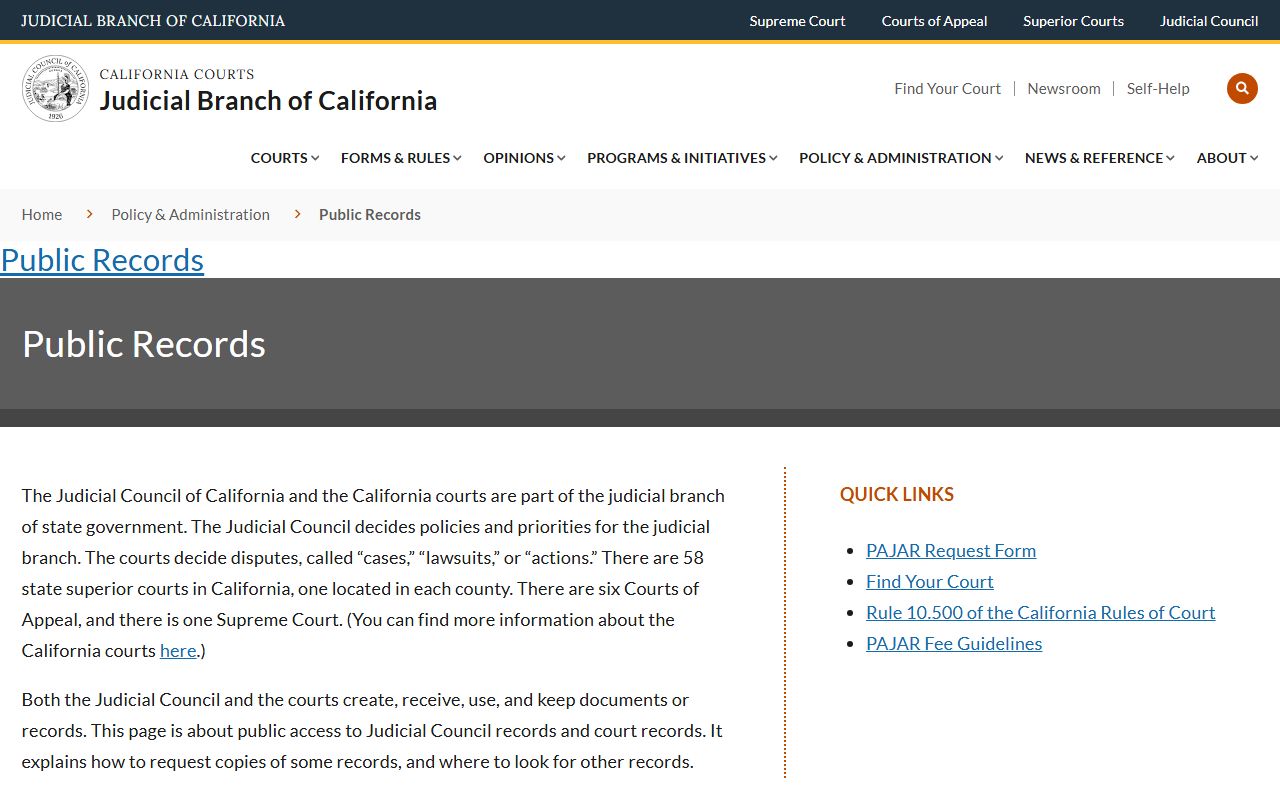
The same Judicial Branch page links to the rules that drive day-to-day access in every county.
Key Statutes:
California Government Code § 7920.000 - Names the California Public Records Act and sets the open-records baseline for state and local agencies.
California Rule of Court 2.503 - Limits remote public access to family, juvenile, mental health, and other sensitive case files.
Welfare and Institutions Code § 827 - Keeps juvenile case files confidential and limits access to authorized people.
Code of Civil Procedure § 1161.2 - Blocks public access to most unlawful detainer cases until statutory conditions are met.
Penal Code § 851.91 - Allows a person to petition to seal an arrest that did not result in a conviction.
Records That Are Restricted or Confidential
Not every Contra Costa case file is public. Juvenile delinquency and dependency cases are sealed by law. Adoption files are sealed under Family Code section 9200. Mental health and conservatorship records hold private medical and capacity facts that the public cannot view. Sealed search warrant affidavits and grand jury material stay closed until a court order says otherwise. Limited unlawful detainer cases are blocked from online view in Contra Costa County. Domestic violence cases may hide protected addresses and minor names.
To view a sealed file, a person must petition the Superior Court under Rule of Court 2.550. The court applies a strict test. The order must be narrow. The interest in sealing must clearly outweigh open access. To clear a prior conviction, many people file under Penal Code section 1203.4. To clear an arrest with no conviction, the petition runs under Penal Code section 851.91. Both petitions are filed in the court that handled the case.
Specialty Courts in Contra Costa County
The Superior Court runs collaborative justice programs that mix court review with treatment. The court calls them problem-solving courts. They use judicial supervision, probation, treatment providers, drug testing, and frequent review hearings. Common areas include drug and treatment court, behavioral health or mental health court, and veterans diversion. The Sheriff and the court also discuss reentry programs that help people leaving jail connect with services. Eligibility usually depends on the charge, the diagnosis, the DA, and the defense.
Drug court mixes probation, testing, and counseling with frequent reviews. Behavioral health court takes cases where a mental health condition drives the charge, with treatment goals in place of pure custody. Veterans diversion routes some service-related cases out of standard sentencing. The court page does not always publish each program judge or roster, so the local rules and the Public Defender remain the best contacts for current eligibility.
Contra Costa County Sheriff and Jail
Sheriff-Coroner David O. Livingston leads the Contra Costa County Office of the Sheriff. His official biography says he was elected the 22nd Sheriff in 2010 and sworn into his current term on January 3, 2023. The Custody Services Bureau runs three jails: the Martinez Detention Facility at 901 Court Street, the West County Detention Facility at 5555 Giant Highway in Richmond, and the Marsh Creek Detention Facility at 12000 Marsh Creek Road in Clayton. The Sheriff also runs a Custody Alternative office that supervises about 425 clients on home detention, work alternative, county parole, alcohol monitoring, and pretrial release.
For a full booking lookup, the Sheriff posts an In-Custody Locator. Use the locator first, then call the facility to confirm release status. The site links to the locator, mail rules, and visit blocks. For day-to-day jail use, see the Contra Costa County inmate records page for the full roster details and the warrant records page for active warrants. The District Attorney is Diana Becton, the 25th DA, and the Public Defender is Ellen McDonnell.
Marriage, Divorce, and Probate Records
The Contra Costa County Clerk-Recorder handles marriage licenses, recorded deeds, fictitious business names, and similar non-court files. The Clerk-Recorder portal at crsecurepayment.com covers those modules in English and Spanish. The Superior Court holds divorce judgments and family-law files. The Probate Division holds wills, trusts, estates, conservatorship, and guardianship files. See marriage and divorce records for the divorce roadmap and probate records for the probate workflow.
The Clerk-Recorder portal lets users search recorded documents and order copies online.
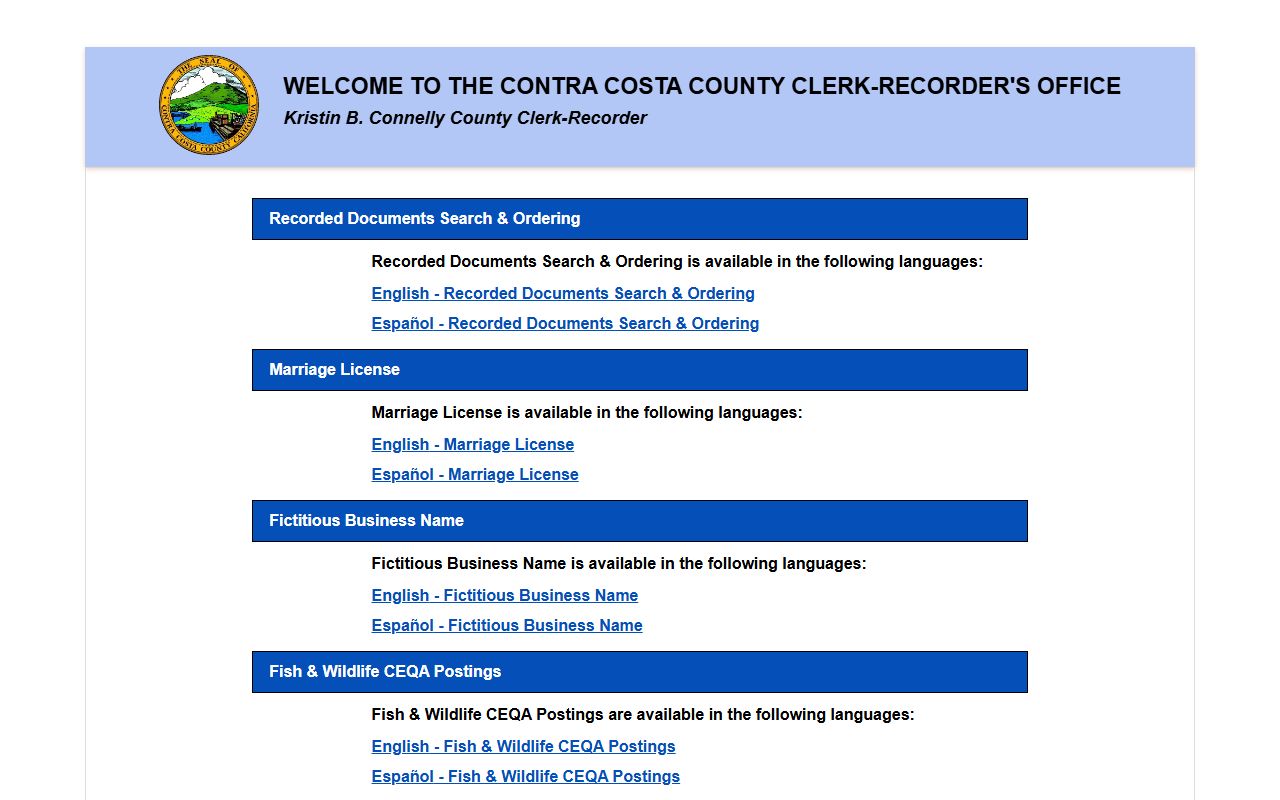
The same portal handles marriage license requests and fictitious business name filings.
- Testator
- The person who made the will being offered for probate.
- Executor
- The person named in the will to carry out the estate and answer to the court.
- Conservator
- An adult appointed by the judge to care for another adult who cannot care for self or finances.
Contra Costa County Court Records Fees
The Superior Court posts its full schedule on the fees page. Copy and certification fees at the Court Records Unit are set by court order. The court takes cash, check, money order, and credit or debit card at the clerk windows. Credit and debit card payments at court add a 2.99% service fee with a $1 minimum. Online traffic payments add a 3.99% service fee. Low-income filers can ask for a fee waiver using forms FW-001 and FW-003.
A look at the official fee page shows the full set of charges, the drop-box rules, and the fee-waiver path.
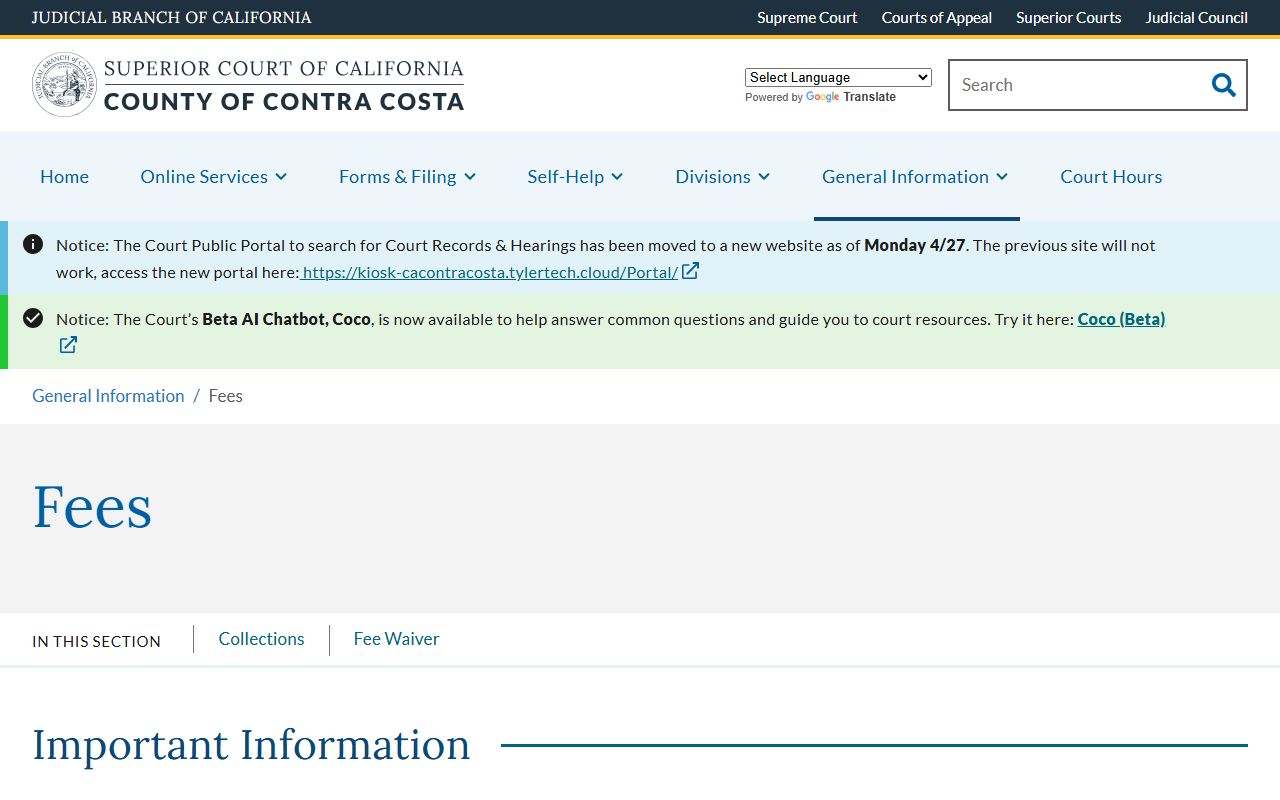
The fee page also covers court-ordered fines and the collections agency used by the court.
| Item | Amount |
|---|---|
| Plain copy per page | $0.50 |
| Certified copy | $40 plus $0.50 per page |
| Certified divorce judgment (copies included) | $15 |
| In-court credit or debit card service fee | 2.99% (minimum $1) |
| Online traffic payment service fee | 3.99% |
How to Interpret Contra Costa County Court Records
Court files use short codes and stock phrases. A docket line that reads "ARR" often means arraignment. "MTD" can mean motion to dismiss. "DISP" marks disposition. Civil cases use "JGT" for judgment and "SAT" for satisfaction of judgment. A charge is not the same as a conviction. A charge is the accusation. A conviction is the finding or plea of guilt that follows. A dismissal closes the case without a conviction, but the arrest can still show in some databases unless sealed.
Family law and probate docket lines lean on form numbers. FL-100 is the divorce petition. FL-110 is the summons. GC-51 is the parental diagram for guardianship. Probate calendar notes appear on the Court Public Portal six to eight days before the hearing. The Online Services page is the best starting point for any reader new to the codes.
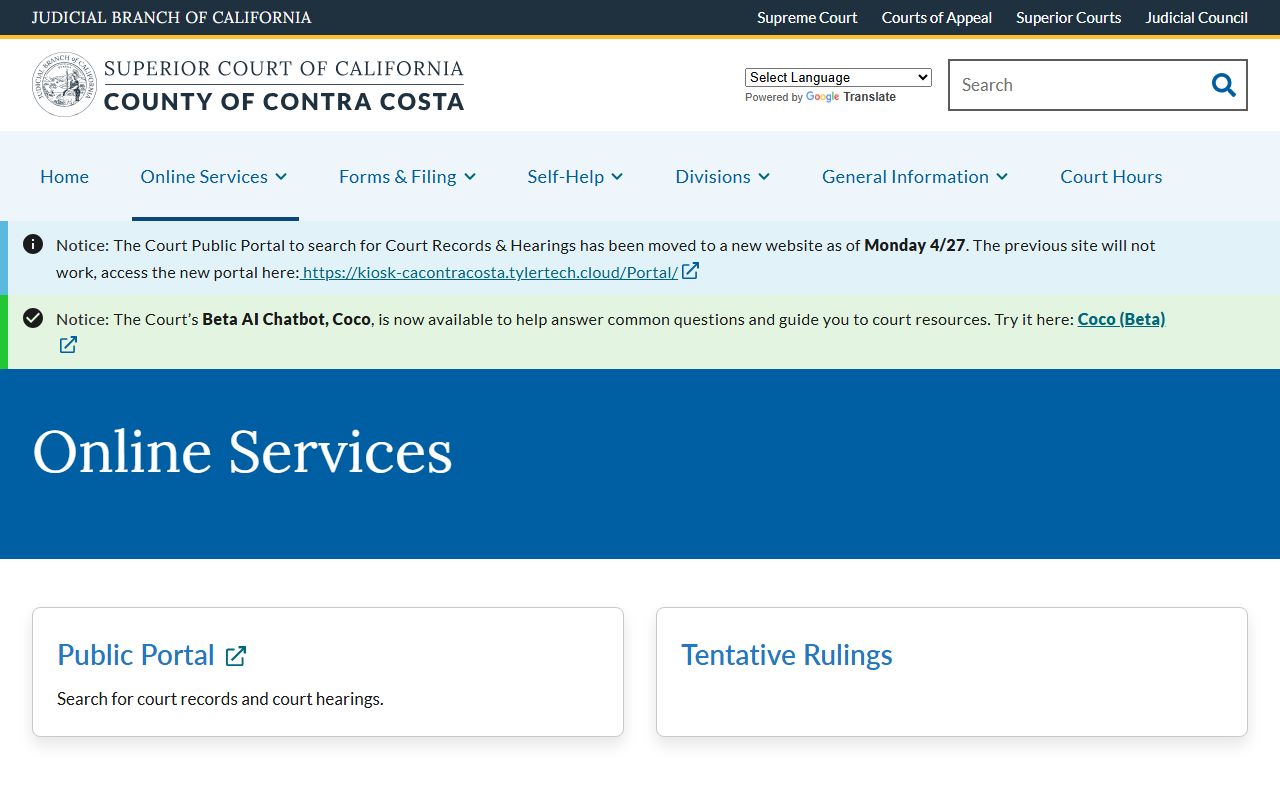
The same page links to tentative rulings, court calendars, electronic recordings, MyCitations, and self-help.
Accuracy and Record Limitations
The Court Public Portal terms state that portal content is not the official court record. Updates can lag the paper or e-filed record by hours or days. Old microfiche and microfilm files are being scanned, which can delay any request. To fix a record error, contact the assigned division at the courthouse where the case was filed. Use Court Records at Room 103 in Martinez for non-criminal case files. For criminal case files, contact the criminal clerk at the courthouse of record.
Note: Confirm any case detail with the originating office before acting on it; the portal is a lookup tool, not the official certified record of the court.
History of Contra Costa County Courts
Contra Costa County is one of California's original 27 counties, formed in 1850. Martinez has served as the county seat from the start. The modern Superior Court reflects the 1998 unification of municipal and superior courts into one trial court per county. The Arnason Justice Center page notes that it serves the former Delta Judicial District. George D. Carroll Courthouse anchors Richmond. Recent milestones include the April 27, 2026 move of the Court Public Portal to a Tyler-hosted site and the launch of the Coco beta AI chatbot in February 2026.
Frequently Asked Questions
How do I search Contra Costa County court records online?
Start at the Superior Court Online Services page and pick Court Public Portal. As of April 27, 2026, the portal lives at kiosk-cacontracosta.tylertech.cloud/Portal/. Search by case number when possible. If the case is not found, run a name search and try other court locations. Traffic citations use the separate Traffic Public Portal at cmsportal.cc-courts.org/TrafficPortal/. The portal is free to use, but content is not the official record.
Where is Court Records located?
Court Records for non-criminal cases sits at the Wakefield Taylor Courthouse, 725 Court Street, Room 103, Martinez, CA 94553. The phone is (925) 608-1000. The court posts hours of 8 a.m. to 4 p.m. Monday through Friday, except holidays. Court phones are answered from 8 a.m. to 3 p.m. A valid photo ID is required to view any paper file in person. Mail requests are also accepted with self-addressed stamped envelopes and the right fees.
What does it cost to get certified copies?
Plain copies cost $0.50 per page at the Court Records Unit. A certified copy costs $40 plus $0.50 per page. A certified divorce judgment costs $15 and includes the copies. Credit and debit payments at court add a 2.99% service fee with a $1 minimum. Online traffic payments add 3.99%. Low-income filers may ask for a fee waiver using Judicial Council forms FW-001 and FW-003. The court fees page lists every charge in one place.
More on the Contra Costa County Court Records FAQ page.